Education for Investors
What’s the Difference? STR, Airbnb, VRBO, Vacation Homes - Terminology Explained

If you are just diving into the world of short term rentals, Airbnbs, VRBO’s, and vacation homes you might be a little bit confused as to what is the difference between them all.
In this post we are going to explain the exact differences between the lingo and what each verbiage means, and give you ideas as to how to classify your rental property.
Breaking down the industry lingo so you know how to categorize your property

Defining the Terminology
What is a Short-Term Rental (STR)?
A short-term rental is an industry-wide umbrella term for any property that is rented out for brief periods, typically less than thirty days. This also refers to rental properties, regardless of whether they are in a vacation market or not.
The property could be a single family home, apartment in the city, camper on a farm, or even a private room.
Properties that are listed on the website platforms of Airbnb.com, VRBO.com, vacation rentals on property management websites that are rented out for under 30 days are technically considered short-term rentals.
Short-term rentals are regulated more stringently than other types of rentals - like mid-term rentals or long-term rentals. This is because they blur the lines between residential and commercial use. Municipalities implement strict controls to protect affordable housing stock, preserve neighborhood character, require different taxation, guest safety and to monitor growth of this particular type of business within their jurisdiction.
Regulations differ between city, county, and state levels, so it is wise to do your own research prior to purchase of a property. This may require you connecting directly with local regulating bodies to understand the rules and regulations surrounding your particular city.
An Airbnb is a slang term for a short-term rental property that is listed on the Online Travel Agency (OTA) website of Airbnb.com.
Platforms like Airbnb.com are intermediaries bringing together travelers and rental properties. Travelers use Airbnb.com to search many different rental properties all within a single user experience, on the app or website, giving them the ability to search internationally, filter for different properties or amenities, and save rentals that they want to visit in the future.
Airbnb.com consistently ranks as one of the top five most visited travel and tourism websites globally with an average of 100 million to 120 million global visitors per month. With the majority of its social media referrals coming from LinkedIn at 31.8% of total traffic.*1
Because of this volume of traffic, short-term rental owners and managers leverage Airbnb.com to give their property a greater level of visibility and to an audience that is looking for properties to stay at instead of a hotel while they travel.
What is an Airbnb?
Airbnb is unique because:
Showcasing a variety of property types: entire homes, private rooms, shared spaces, even unique stays like tree houses or converted barns
It serves a broad mix of travelers: solo adventurers, couples, business travelers, and groups.
It charges a service fee to both the host and the guest on each booking.
It’s known for it’s review system which builds trust between strangers on both sides of the transaction.

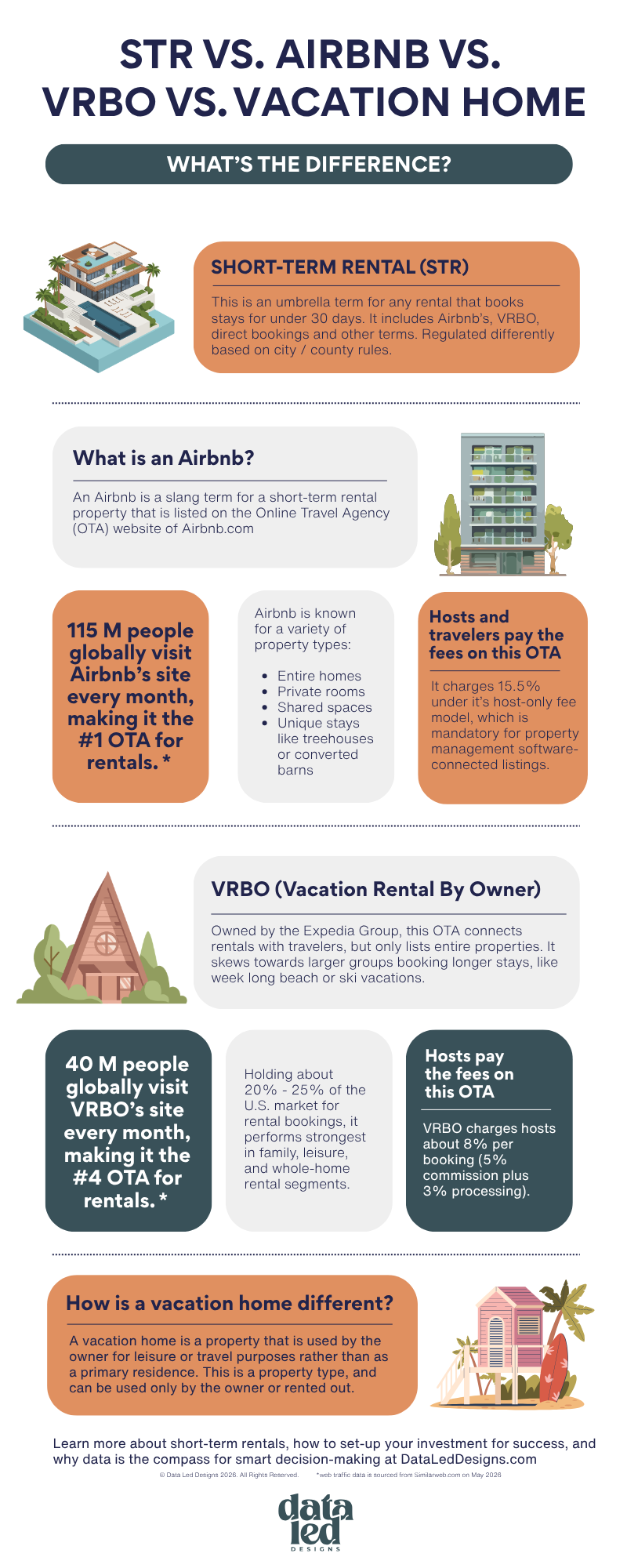

VRBO is an Online Travel Agency platform like Airbnb, it stands for Vacation Rental By Owner, and owned by the Expedia group. It operates similarly to Airbnb in that it connects property owners with travelers but there are some important differences.
Here is how they differentiate:
VRBO only lists entire properties. You won’t find shared rooms or partial-home listings here.
Its guest base skews towards familiars and larger groups booking for longer stays, like week long beach trips or ski vacations.
Hosts can choose between paying per booking or subscribing to an annual plan.
It tends to attract guests who are specifically searching for a vacation rental rather than a hotel alternative
When looking at the platform from a web traffic perspective it has about 50 Million users a month with the majority of its social media referrals coming from Facebook at 70% of all social media traffic.
What is VRBO?

What is a vacation home?
A vacation home is a property that is used by the owner for leisure or travel purposes rather than as a primary residence. This is a property type, and not a platform or a category of rental activity.
What differentiates a vacation home:
The owner can use it personally whenever they want (and block off those dates from rental calendars)
When it is rented out, it becomes a short-term rental - and might be listed on Airbnb, VRBO, or with a property management company
Some vacation homes are never rented at all, they are solely for the owner’s personal enjoyment.
Vacation homes are often in desirable destinations: beach towns, mountain resorts, lake communities
To Clarify the Terms:
A vacation rental is what you own.
A short-term rental is what you do with it.
Airbnb and VRBO are how you find guests when you decide to rent it.
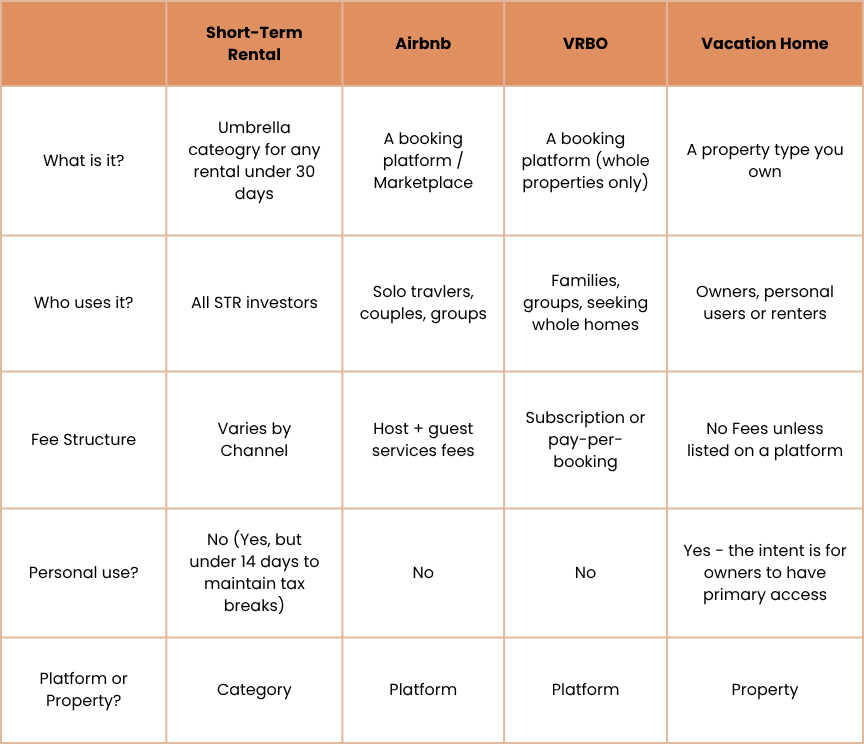
Side by Side: How they compare
Why does this even matter? (Especially if you are an investor)
You might be thinking — okay, interesting, but does it really matter what I call it? The answer is yes, and here's why.
Your Platform Choice Affects Your Guest Profile
If you list exclusively on Airbnb, you're reaching one type of traveler. If you list on VRBO, you're reaching another. Most experienced STR investors list on both, and often add a direct booking website on top, to maximize visibility and occupancy. Knowing the difference helps you make intentional decisions rather than defaulting to what everyone else is doing.
"Short-Term Rental" Has Legal Weight
In most cities and counties, "short-term rental" is a legal term with specific regulations attached to it. Understanding that this is the umbrella category, not just an Airbnb thing, helps you navigate licensing, taxes, and compliance with confidence.
Vacation Home Strategy is Different From Pure STR Investing
If you buy a vacation home primarily for personal use with occasional rental income on the side, your approach to design, location, and management will look very different from someone building an STR portfolio purely for returns. Knowing which model you're pursuing helps you make smarter decisions from the start.
Data Should Drive Every Decision
Whether you're choosing between Airbnb and VRBO, deciding which market to invest in, or figuring out how to design and price your property — data matters. At Data Led Designs, we believe that the best short-term rental investments are built on real market intelligence, not guesswork. Understanding your terminology is step one. Using data to inform what you do next is how you win.

5 Common Misconceptions — Cleared Up
Myth #1: "Airbnb and VRBO are basically the same thing."
They're both platforms, but they attract different audiences and operate differently. Airbnb is broader; VRBO leans toward families and whole-home stays. The platform you choose (or whether you use both) is a strategic decision.
Myth #2: "Short-term rental just means Airbnb."
Nope! Airbnb is one channel within the much larger STR world. You can run a short-term rental without ever using Airbnb — through VRBO, direct booking, property management companies, or other platforms.
Myth #3: "If I own a vacation home, I'm automatically an STR operator."
Only if you rent it out. A vacation home you keep entirely for personal use is not a short-term rental. The moment you start accepting guests and charging rent, it crosses into STR territory — and regulations apply.
Myth #4: "Airbnb is just for budget stays."
Airbnb's luxury segment has grown significantly. High-end villas, designer properties, and premium stays are increasingly common on the platform. Don't assume platform equals price point.
Myth #5: "STRs are always more profitable than long-term rentals."
This depends heavily on your market, your management costs, local regulations, and your property. In some markets, STRs dramatically outperform long-term rentals. In others, the extra work and seasonality make long-term rentals the smarter play. Data and not assumptions are what should drive that decision.

Quick Reference: The Four Terms in One Sentence Each
Short-Term Rental
The umbrella category for any property rented for less than 30 days — regardless of platform.
Airbnb
A booking platform that connects hosts with a wide range of travelers, from budget to luxury.
VRBO
A booking platform focused on whole-property rentals, popular with families and groups.
Vacation Home
A property you own for leisure use that may or may not be rented out to guests.
The Bottom Line
The short-term rental world has its own language, and getting comfortable with these terms is one of the first steps to investing with confidence. To recap:
• Short-term rental is the category — the what.
• Airbnb and VRBO are platforms — the where you list.
• Vacation home is the property type — the thing you own.
Once you understand the difference, you can start making strategic decisions about which platforms to use, what kind of property to invest in, and how to position yourself in your market.
And when you're ready to go deeper into data-backed market selection, pre-acquisition market analysis, or looking for a major pivot, that's exactly where Data Led Designs comes in. Because the best STR investors don't guess. They use data.
Ready to Make Confident, Profitable STR Investments?
At Data Led Designs, our Market Insight Reports give you the exact data successful investors use to:
Identify high-performing locations with real demand
Understand who your ideal guests are and what they value
Calculate ROI-driven amenity investments
Position your property to outperform your market
Stop guessing. Start profiting.
📍 Explore Market Insight Reports
🎓 Coaching program launching soon—be the first to know!